

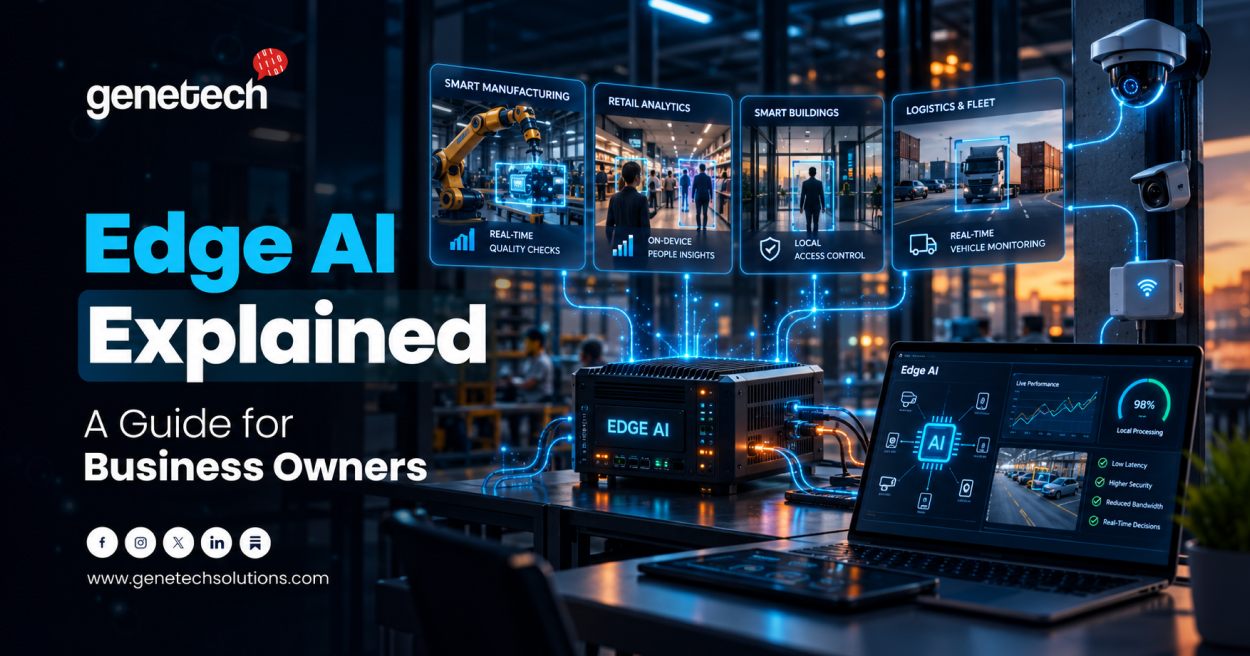
Edge AI means running an AI model directly on a device or local server, right where the data is created, instead of shipping it to a distant cloud data center and waiting for an answer. That shift, processing moving from “somewhere far away” to “right here,” is why the term has started showing up everywhere, from security camera pitches to POS vendor decks.
If you run a retail location, a warehouse, a fleet, or a hospitality business, you’re probably already using cloud-based AI tools that feel slow, expensive, or unreliable the moment the connection drops or a decision needs to happen instantly. Here’s what edge AI actually is, why it’s picking up speed, and how to tell whether it’s a real upgrade for your business or just the next buzzword.
What Is Edge AI?
In one sentence: edge AI is AI inference; the “running” part of a trained model, not the training itself, happening on the device or local server where the data originates, instead of being sent to a centralized cloud data center for processing.
A security camera that decides for itself whether it just saw a person or a stray cat, without uploading footage anywhere, is doing edge AI. A checkout kiosk that recognizes a product on its own camera feed in real time is doing edge AI. The “edge” is simply the physical edge of your network — the store floor, the factory line, the delivery truck — as opposed to a server farm hundreds of miles away.
Why Is Edge AI Accelerating Right Now?
Three things are converging, and none of them are hype.
AI models, especially smaller, purpose-built ones, have gotten efficient enough to run on modest local hardware, paired with chips designed specifically for on-device inference. Meanwhile, real-time decisions are becoming table stakes: a second of lag at checkout is a bad customer experience; a second of lag on a factory line when a defect passes a sensor is a quality problem, or worse. And data volume keeps growing; every added camera or sensor adds to a bandwidth bill that scales with your footprint, not your revenue, making “just send it all to the cloud” increasingly impractical.
The market numbers back this up as a real trend. The global edge computing market is projected to grow from roughly $111 billion in 2026 to about $317 billion by 2031, a CAGR near 23%, per MarketsandMarkets. IDC separately forecasts global edge infrastructure spending growing at a 13.8% CAGR to nearly $380 billion by 2028, driven largely by AI workloads moving closer to where data is generated.
Edge AI vs. Cloud AI: What’s Actually Different for Your Business
The two aren’t rivals so much as tools for different jobs; most businesses that adopt edge AI end up running both.
- Speed: Edge AI answers locally, often in milliseconds. Cloud AI sends data out and waits for a round trip, fine most of the time, but noticeable exactly when speed matters: a checkout line, a safety alert, a line fault.
- Reliability: Edge AI keeps working through an internet outage. A cloud-dependent tool stalls.
- Cost: Genuinely mixed. Edge AI can lower ongoing bandwidth and cloud costs at high volume, but it carries upfront hardware costs, and at low volume the math doesn’t automatically favor it. Don’t take a vendor’s savings pitch at face value.
- Data exposure: Sensitive data, faces on camera, production data, patient information, can stay on-site instead of being transmitted off.
In practice, this plays out as a hybrid: the edge handles the time-sensitive, local decision; the cloud still handles storage, heavier analytics, and coordination across locations. If you’ve already hit cloud limitations around cost or lock-in, Genetech’ Solutions’ rundown of common cloud computing challenges covers the flip side of this trade-off.
Edge AI and Where Your Knowledge Base Lives
If your edge AI setup includes an assistant or chatbot that answers questions using your company’s own documents, a growing use case alongside cameras and sensors, there’s a second decision hiding inside the “edge vs. cloud” question: where does the knowledge base live, not just where does the model run?
That distinction matters because of how these AI assistants actually work. Most business-facing AI assistants use a method called retrieval-augmented generation, or RAG: instead of answering purely from what the model memorized during training, it looks up relevant information from your company’s own documents first, then uses that to write its answer. Think of RAG as giving the AI a filing cabinet to check before it responds, rather than asking it to answer from memory alone.
Here’s the part that trips up the “edge AI keeps your data private” argument: the model and the filing cabinet it searches are two separate things, and they don’t have to be in the same place. A model running locally on your hardware can still reach out to a cloud-hosted knowledge base for that lookup step, call it edge AI with cloud-based retrieval. This setup is common, and often the right call: it’s genuinely hard to keep a large, constantly-changing knowledge base, a full product catalog, an evolving policy manual, records across dozens of locations, in sync on every local device. But it means the privacy benefit people associate with edge AI doesn’t fully apply here, because queries and the information retrieved to answer them are still leaving the premises, even though the model itself sits on-site.
The combination that actually keeps everything local is edge AI paired with a local knowledge base, the model runs on-site, and so does what it’s searching. That’s the setup to insist on if data sensitivity is the reason you’re considering edge AI in the first place, rather than assuming any local model automatically delivers it.
Ready to take your architecture to the next level? Building robust RAG pipelines is notoriously complex, with common pitfalls hidden in chunking and data prep. Check out the full breakdown on building production-ready RAG here.
Where Edge AI Already Shows Up in Everyday Operations
- Retail: Amazon Go’s cashierless stores run local inference to identify items as shoppers pick them up, with no cloud round-trip needed for the moment-to-moment decision. Loss-prevention systems increasingly flag suspicious scans or concealment attempts on-device, without shipping raw footage offsite.
- Manufacturing: On automotive lines, AI vision inspection catches defects in real time as parts move down the line rather than sampling after the fact; BMW has reported meaningful defect reductions using AI-driven inspection across production.
- Logistics: Fleet and cold-chain tracking needs to keep working in low-connectivity areas — a refrigerated truck can’t afford a monitoring gap just because it lost signal for twenty minutes.
- Hospitality: On-site occupancy, security, or personalization systems often can’t tolerate the delay of a cloud round trip without the experience feeling broken.
What Edge AI Actually Solves for a Business Owner
- Faster response where speed affects revenue or safety.
- Resilience when connectivity isn’t guaranteed.
- Lower ongoing cloud costs at scale, with a real caveat: this depends heavily on data volume. A single low-traffic location with a couple of cameras is unlikely to see meaningful savings; a forty-location chain running continuous video across every lane is a different story.
Common Mistakes and Misconceptions
- Assuming edge AI replaces the cloud entirely. Most real deployments are hybrid; the edge handles local decisions, and the cloud still handles storage and coordination.
- Underestimating device management overhead. Every camera or kiosk running local AI is now a device that needs updates, monitoring, and security patching- ongoing work, not a one-time purchase.
- Expecting savings that don’t materialize at low volume. Edge economics favor continuous, high-volume data streams. A single low-traffic site may see no meaningful benefit.
- Buying hardware before defining the problem. Start with “which specific delay or cost is actually hurting us,” not “we should get edge AI.” The technology should follow the business problem.
A Practical Checklist: Is Edge AI Worth Exploring for Your Business?
- Does a delay of even a few seconds — checkout, security response, fault detection — create real cost or risk?
- Do any locations have unreliable or expensive connectivity that a cloud-dependent tool would struggle with?
- Are you generating continuous data from multiple devices, rather than occasional, low-volume data?
- Is any of the data sensitive enough that keeping it on-site matters for privacy or compliance?
- Do you have, or can you budget for, someone who can manage and secure the local devices themselves?
Two or more checked means edge AI is worth a real conversation, not a purchase yet, but a scoping conversation with a technology partner who isn’t the one selling you the hardware.
Why This Is a Strategic Decision, Not Just a Technical One
The question underneath all of this, where this should actually run, isn’t one to answer from a hardware vendor’s pitch deck. It’s a decision about your operational risk, cost structure, and data sensitivity, worth working through with a partner who isn’t the one selling the cameras.
Genetech Solutions works with businesses on exactly this kind of question, through AI-Powered Business Solutions built around a specific operational problem rather than a generic AI package, and through Product Engineering when a business needs a new system architected around edge data from the ground up. For logistics operations specifically, our logistics and supply chain work touches many of the same real-time, low-connectivity problems edge AI is meant to solve.
If you checked a couple of boxes above and your current setup is creating delays, connectivity issues, rising data costs, or is slow or too fragile, it’s worth talking through your specific setup rather than guessing from a vendor brochure. We’d be glad to join that conversation.


